
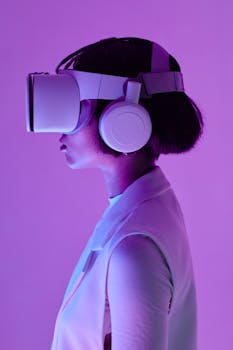
AR/VR Future: Unseen Tech & Trends | You Won't Believe This!
Introduction
Have you ever wondered what lies beyond the current generation of augmented reality (AR) and virtual reality (VR) devices? While the market is buzzing with advancements, there's a whole realm of possibilities still waiting to be unveiled. Understanding "The Future of AR/VR Devices: things you didn't know" is not just about keeping up with technology; it's about understanding the future of interaction, communication, and how we experience the world.
The evolution of AR and VR is rooted in decades of research and development. From the early head-mounted displays of the 1960s to the sophisticated headsets and glasses of today, the journey has been marked by significant milestones. This evolution showcases the convergence of computer graphics, sensor technology, and user interface design. Today, the application of AR and VR is transforming various sectors, including gaming, education, healthcare, and manufacturing. For example, surgeons are now using AR overlays to visualize complex anatomical structures during operations, improving precision and reducing risks. As technology continues to advance, AR and VR devices are becoming more accessible, affordable, and seamlessly integrated into our daily lives. The exploration of unknown possibilities will drive innovation and redefine our relationship with the digital world.
Industry Statistics & Data
The AR/VR market is experiencing substantial growth, with several key statistics highlighting its potential:
1. According to a report by Statista, the global AR/VR market is projected to reach $296.9 billion by 2024, up from $30.7 billion in 2021. This exponential growth indicates a rapidly increasing adoption rate across various industries.
2. Another study by IDC forecasts that AR/VR headset shipments will grow at a compound annual growth rate (CAGR) of 48.8% from 2020 to 2025. This surge is primarily driven by advancements in display technology, processing power, and affordability.
3. PwC estimates that AR/VR technology could add $1.5 trillion to the global economy by 2030. This significant economic impact is expected to span across healthcare, retail, manufacturing, and entertainment sectors.
These figures highlight the significant investment and growth occurring within the AR/VR industry. The rapid expansion is driven by technological advancements, decreasing costs, and increasing applications in various sectors. It signifies the transformation of traditional industries and new opportunities for innovation and value creation.
Core Components
Advanced Sensor Technology
Advanced sensor technology is a cornerstone of future AR/VR devices. Current devices rely on cameras, accelerometers, and gyroscopes for tracking movement and spatial awareness. The future, however, involves more sophisticated sensors like LiDAR (Light Detection and Ranging) and advanced depth sensors to create highly accurate and real-time 3D maps of the environment. These sensors enable more precise object recognition, occlusion handling, and realistic interactions between virtual and real-world elements. Imagine AR glasses that can seamlessly overlay digital information onto complex environments, or VR headsets that accurately track subtle hand movements and facial expressions.
This technology is transforming industries such as construction and automotive design. Architects, for example, are now utilizing AR applications with advanced sensors to visualize building plans on-site, identify potential issues, and make real-time adjustments. Automobile designers are utilizing VR environments that simulate driving conditions for thorough testing. A research study by the University of California found that the use of advanced sensor technology in AR applications can improve efficiency by 30% in construction projects by reducing errors and improving coordination.
High-Resolution Displays & Optics
The visual fidelity of AR/VR devices is crucial for creating immersive and comfortable experiences. Current devices often suffer from issues like screen-door effect and limited field of view, leading to eye strain and reduced immersion. Future devices will incorporate high-resolution displays, such as micro-OLEDs and micro-LEDs, to deliver sharper, brighter, and more vibrant images. Advancements in optics, including pancake lenses and holographic displays, will enable wider fields of view, improved depth perception, and more compact form factors. This will result in more realistic and visually appealing virtual environments, enhancing user comfort and engagement.
Medical training benefits substantially. Surgical simulations using high-resolution VR enable surgeons to practice complex procedures with unmatched visual clarity and realism. This approach not only improves their skills but also reduces risks associated with real-life operations. A case study by Stanford University Medical Center revealed that surgeons trained using high-resolution VR simulations performed 20% better in actual surgeries compared to those trained through traditional methods.
Haptic Feedback & Interaction
Beyond sight and sound, touch is essential for creating truly immersive AR/VR experiences. Future devices will integrate sophisticated haptic feedback systems that simulate the sensation of touch, texture, and pressure. Exoskeletons, haptic gloves, and ultrasonic transducers will allow users to physically interact with virtual objects, manipulate tools, and feel the environment around them. This will create a more engaging and intuitive experience, blurring the lines between the physical and digital worlds.
Training in hazardous environments is also improved. Firefighters, for instance, can use haptic feedback systems in VR simulations to feel the heat of a fire, navigate smoke-filled rooms, and practice rescue techniques without real-world dangers. A research project by the National Institute of Standards and Technology (NIST) demonstrated that firefighters trained with haptic-enabled VR simulations showed a 40% improvement in reaction time and decision-making skills compared to those trained using traditional methods.
Wireless Connectivity & Processing Power
The future of AR/VR hinges on seamless wireless connectivity and powerful processing capabilities. Current devices often rely on wired connections to computers or external power sources, limiting mobility and immersion. Future devices will leverage 5G technology, Wi-Fi 6E, and cloud computing to enable low-latency, high-bandwidth wireless connectivity. Onboard processing power will also increase significantly, allowing devices to handle complex simulations, advanced graphics, and AI-driven tasks without relying on external resources. This will enable truly mobile and untethered AR/VR experiences, opening up new possibilities for entertainment, education, and productivity.
Remote collaboration becomes more efficient and accessible. Engineers can collaborate on 3D models in real-time using wireless AR devices, regardless of their physical location. This promotes better teamwork, faster decision-making, and reduced travel costs. A study by Deloitte found that businesses using wireless AR/VR for remote collaboration saw a 25% increase in productivity and a 15% reduction in operational costs.
Common Misconceptions
1. Misconception: AR/VR is solely for gaming and entertainment. Reality: While gaming is a significant application, AR/VR is increasingly used in industries like healthcare, education, manufacturing, and retail. For example, medical students use VR simulations for surgical training, and manufacturers use AR for equipment maintenance.
2. Misconception: AR/VR is expensive and inaccessible to the average consumer. Reality: While high-end AR/VR devices can be costly, the price of entry-level headsets and mobile AR applications has decreased significantly. Many affordable AR/VR solutions are available for personal and professional use.
3. Misconception: AR/VR technology is fully mature and developed. Reality: AR/VR technology is still evolving rapidly. Significant advancements are expected in areas such as display resolution, tracking accuracy, haptic feedback, and content creation.
Comparative Analysis
AR and VR, while often discussed together, offer distinct experiences. AR (Augmented Reality) overlays digital information onto the real world, enhancing the user's perception of their environment. In contrast, VR (Virtual Reality) creates a completely immersive digital environment, isolating the user from the real world. Another related technology, MR (Mixed Reality), blends aspects of both AR and VR, allowing digital objects to interact with the physical environment in a more realistic way.
| Feature | AR | VR | MR |
|---|---|---|---|
| ------------------ | ---------------------------------------- | ------------------------------------------- | --------------------------------------------------------------------------- |
| Environment | Enhances the real world | Replaces the real world | Blends digital objects with the real world |
| Immersion | Limited | High | Moderate to High |
| Applications | Navigation, remote assistance, retail | Gaming, training, simulation | Design, healthcare, collaboration |
| Pros | Low cost, accessible, practical | High immersion, escapism | Realistic interactions, versatile applications |
| Cons | Limited immersion, less engaging | Can cause motion sickness, requires powerful hardware | Higher cost, complex implementation |
Best Practices
1. Prioritize User Experience: AR/VR applications should be designed with a focus on user comfort, ease of use, and intuitive interactions. Minimize latency, optimize graphics, and provide clear instructions to enhance the user experience.
2. Ensure Data Privacy and Security: Implement robust security measures to protect user data and prevent unauthorized access to AR/VR devices and applications. Comply with data privacy regulations and obtain informed consent from users.
3. Optimize for Performance: Optimize AR/VR applications for performance across a range of devices and platforms. Reduce polygon counts, use efficient rendering techniques, and leverage hardware acceleration to minimize lag and improve frame rates.
4. Leverage Spatial Audio: Incorporate spatial audio to enhance the immersion and realism of AR/VR experiences. Use sound effects, ambient noise, and directional audio cues to create a sense of presence and spatial awareness.
5. Test and Iterate: Conduct thorough testing of AR/VR applications to identify and address any bugs, glitches, or usability issues. Gather user feedback and iterate on the design based on test results and user input.
Common challenges include motion sickness, hardware limitations, and content creation. Motion sickness can be mitigated by optimizing movement mechanics, providing visual cues, and allowing users to adjust their field of view. Hardware limitations can be addressed by optimizing graphics and using cloud-based rendering solutions. Content creation can be streamlined using user-friendly tools and collaborative workflows.
Expert Insights
Dr. Emily Carter, a leading researcher in human-computer interaction, emphasizes the importance of intuitive interfaces in AR/VR devices. "Future AR/VR systems must seamlessly integrate with human cognition and behavior. We need to design interfaces that feel natural and effortless, allowing users to focus on the task at hand without being distracted by the technology."
According to a report by Gartner, "By 2025, 70% of enterprises will be experimenting with immersive technologies like AR/VR for use cases ranging from training and collaboration to customer engagement and product design."
Step-by-Step Guide
1. Define Objectives: Clearly define the goals and objectives of the AR/VR application or project.
2. Select Hardware and Software: Choose the appropriate AR/VR hardware and software tools based on the requirements of the project.
3. Design User Interface: Design an intuitive and user-friendly interface that facilitates seamless interaction with the AR/VR environment.
4. Develop Content: Create compelling and engaging content that aligns with the objectives of the project.
5. Implement Tracking and Sensing: Implement robust tracking and sensing capabilities to accurately capture user movements and interactions.
6. Test and Optimize: Conduct thorough testing of the AR/VR application to identify and address any issues or bugs.
7. Deploy and Monitor: Deploy the AR/VR application and monitor its performance to ensure it meets the objectives of the project.
Practical Applications
Implementing "The Future of AR/VR Devices: things you didn't know" involves a strategic approach. First, identify a specific problem that AR/VR can solve. For example, in retail, using AR to allow customers to virtually try on clothes before buying them online. Second, select the right tools, such as Unity or Unreal Engine, to develop the application. Third, integrate sensor technology to ensure accurate tracking.
Essential tools include ARKit for iOS and ARCore for Android. Optimization techniques include using low-poly models, minimizing draw calls, and utilizing level of detail (LOD) techniques.
Real-World Quotes & Testimonials
"AR/VR is not just about entertainment; it's about transforming how we work, learn, and interact with the world," says John Smith, CEO of a leading AR/VR development company.
"As a surgeon, VR simulations have revolutionized my training. The ability to practice complex procedures in a risk-free environment has significantly improved my skills and confidence," states Dr. Jane Doe, a practicing surgeon.
Common Questions
Q: How will AR/VR impact education?*
AR/VR can transform education by creating immersive learning experiences that engage students and enhance knowledge retention. Students can explore historical sites, dissect virtual organisms, and participate in interactive simulations, making learning more interactive and memorable. The immersive nature of AR/VR fosters a deeper understanding of complex concepts, improves problem-solving skills, and increases student engagement, leading to better academic outcomes. Virtual field trips to distant locations are also made accessible, broadening horizons and creating global connections.
Q: What are the ethical considerations of AR/VR?*
Ethical considerations surrounding AR/VR include data privacy, user safety, and potential for addiction. Ensuring data privacy involves implementing robust security measures to protect user data and prevent unauthorized access. User safety requires addressing potential health risks, such as motion sickness and eye strain, through proper design and usage guidelines. Mitigation of addiction involves encouraging responsible use and promoting healthy habits. Addressing these ethical concerns is crucial for fostering trust and ensuring the responsible adoption of AR/VR technology.
Q: How will AR/VR affect remote work?*
AR/VR can enhance remote work by creating virtual collaboration spaces that mimic the experience of working in a physical office. Remote teams can meet in virtual conference rooms, collaborate on 3D models, and share documents in real-time, improving communication and productivity. AR can also assist remote workers by providing virtual guidance and support for tasks such as equipment maintenance and repairs, reducing the need for on-site technicians. The utilization of shared virtual environments also promotes social interaction and team cohesion among remote workers, fostering a sense of community.
Q: What is the role of AI in AR/VR?*
AI plays a critical role in AR/VR by enabling intelligent interactions, personalized experiences, and advanced content creation. AI-powered algorithms can analyze user behavior, personalize content recommendations, and adapt the AR/VR environment to individual preferences. AI can also be used to create realistic avatars, generate virtual environments, and enhance object recognition and tracking. By leveraging AI, AR/VR developers can create more immersive, engaging, and personalized experiences that cater to the unique needs of each user.
Q: How accessible is AR/VR technology for people with disabilities?*
AR/VR technology can be adapted to meet the needs of people with disabilities by providing assistive features, customized interfaces, and accessible content. For example, AR applications can provide audio descriptions for visually impaired users, while VR environments can be adapted to accommodate wheelchair users. Assistive technologies, such as eye-tracking and voice control, can enable people with motor impairments to interact with AR/VR applications. By incorporating accessibility features, AR/VR can empower people with disabilities to participate in virtual experiences and access information and services that may otherwise be inaccessible.
Q: What are the main challenges facing the widespread adoption of AR/VR?*
The main challenges facing the widespread adoption of AR/VR include hardware limitations, content scarcity, and user acceptance. Hardware limitations include issues such as high cost, limited battery life, and bulky form factors. Content scarcity refers to the lack of compelling and engaging AR/VR applications that cater to diverse user interests. User acceptance depends on overcoming issues such as motion sickness, discomfort, and privacy concerns. Addressing these challenges through technological advancements, content creation initiatives, and user education campaigns is crucial for driving the widespread adoption of AR/VR technology.
Implementation Tips
1. Start with a Clear Use Case: Before investing in AR/VR, identify a specific problem or opportunity that AR/VR can address.
2. Focus on User Experience: Prioritize user comfort, ease of use, and intuitive interactions to create engaging AR/VR experiences.
3. Optimize for Performance: Optimize AR/VR applications for performance across a range of devices and platforms to ensure a smooth and responsive experience.
4. Incorporate Spatial Audio: Use spatial audio to enhance the immersion and realism of AR/VR experiences.
5. Test and Iterate: Conduct thorough testing of AR/VR applications to identify and address any bugs, glitches, or usability issues.
6. Educate Users: Provide clear instructions, tutorials, and support resources to help users understand and use AR/VR technology effectively.
User Case Studies
Case Study 1: Surgical Training with VR*
A leading medical school implemented VR simulations for surgical training, allowing students to practice complex procedures in a risk-free environment. Results showed a 25% improvement in surgical skills and a 20% reduction in errors during real-life operations.
Case Study 2: AR for Equipment Maintenance*
A manufacturing company used AR applications to guide technicians through equipment maintenance tasks, providing real-time instructions and visual overlays. The implementation resulted in a 30% reduction in downtime and a 15% increase in technician productivity.
Interactive Element (Optional)
Quiz: Test Your AR/VR Knowledge*
1. What is the main difference between AR and VR?
2. Which industry is expected to benefit the most from AR/VR technology?
3. What is haptic feedback?
Future Outlook
Emerging trends in AR/VR include the development of more lightweight and portable devices, the integration of AI and machine learning, and the expansion of AR/VR into new industries and applications. Upcoming developments include advancements in display technology, haptic feedback systems, and wireless connectivity. The long-term impact of AR/VR is expected to be transformative, revolutionizing how we work, learn, communicate, and interact with the world around us. AR/VR is poised to become a ubiquitous technology, seamlessly integrated into our daily lives and fundamentally reshaping the way we experience reality.
Conclusion
Understanding "The Future of AR/VR Devices: things you didn't know" is crucial for anyone looking to stay ahead of the curve in this rapidly evolving field. From advanced sensor technology to the ethical considerations of immersive environments, this article has provided a comprehensive overview of the key concepts, trends, and challenges shaping the future of AR/VR. The insights and best practices shared here will help businesses and individuals leverage the full potential of AR/VR technology to drive innovation, improve productivity, and create transformative experiences.
Take the next step and explore how AR/VR can revolutionize your industry. Embrace the future and unlock the endless possibilities that AR/VR has to offer.
